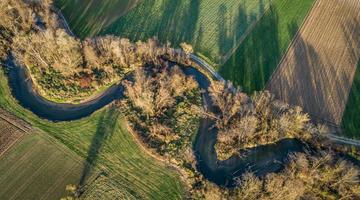
Students explore Nature-Based Solutions in the Front-Running Region Lafnitz
Climate change is increasing pressure on landscapes through more frequent floods, droughts, and heavy rainfall events. In agricultural areas such as the Front-Running Region (FRR) Lafnitz, soil erosion and reduced water infiltration are key challenges, affecting agricultural productivity and increasing sediment inputs into rivers, which can negatively impact aquatic habitats and biodiversity. To explore how Nature-based approaches can strengthen regional resilience, 14 students from the University of Natural Resources and Life Sciences in Vienna visited the FRR Lafnitz. Organised by the beneficiaries STMK, BGLD, and BOKU, the internship combined scientific knowledge with practical experience and demonstrated how Nature-Based Solutions (NbS) can support climate adaptation, water management, biodiversity protection and sustainable land use.
From theory to practice
The internship began with an online lecture on 12 May 2026, introducing students to NbS and their role in addressing climate change, biodiversity loss, and land degradation. Scientific literature provided the basis for discussions during the field activities. On 1 June 2026, students visited six sites across the FRR Lafnitz to explore the Land4Climate project and implemented NbS measures. The excursion showcased various approaches, including flood protection along the Lafnitz River, erosion control, agroforestry systems, water management solutions, multifunctional hedgerows, and sustainable agricultural practices. Representatives from the beneficiaries, Humus+, the Burgenland Chamber of Agriculture and local farmers shared practical experiences and insights into the planning, implementation, and maintenance of these measures. The day concluded with a visit to a machinery fleet in Deutsch Kaltenbrunn, where specialised equipment for selected NbS measures was presented. A follow-up visit to Vienna on 2 June 2026 complemented the programme by showcasing urban NbS addressing challenges such as heat stress and limited green space.
Learning for future climate action
The internship offered students insights into the practical challenges and opportunities of implementing NbS. Beyond individual measures, the field experience highlighted the importance of cooperation, stakeholder involvement and long-term commitment. It strengthened the connection between academic learning and real-world climate adaptation, preparing future landscape planners to develop integrated solutions for resilient regions.
This article was written by Cornelia Jöbstl and Katharina Schüssler from LAND4CLIMATE consortium partner the Office of the Styrian Government


Publishing date: