Financing NbS beyond EU projects: insights from the LAND4CLIMATE session at EURESFO
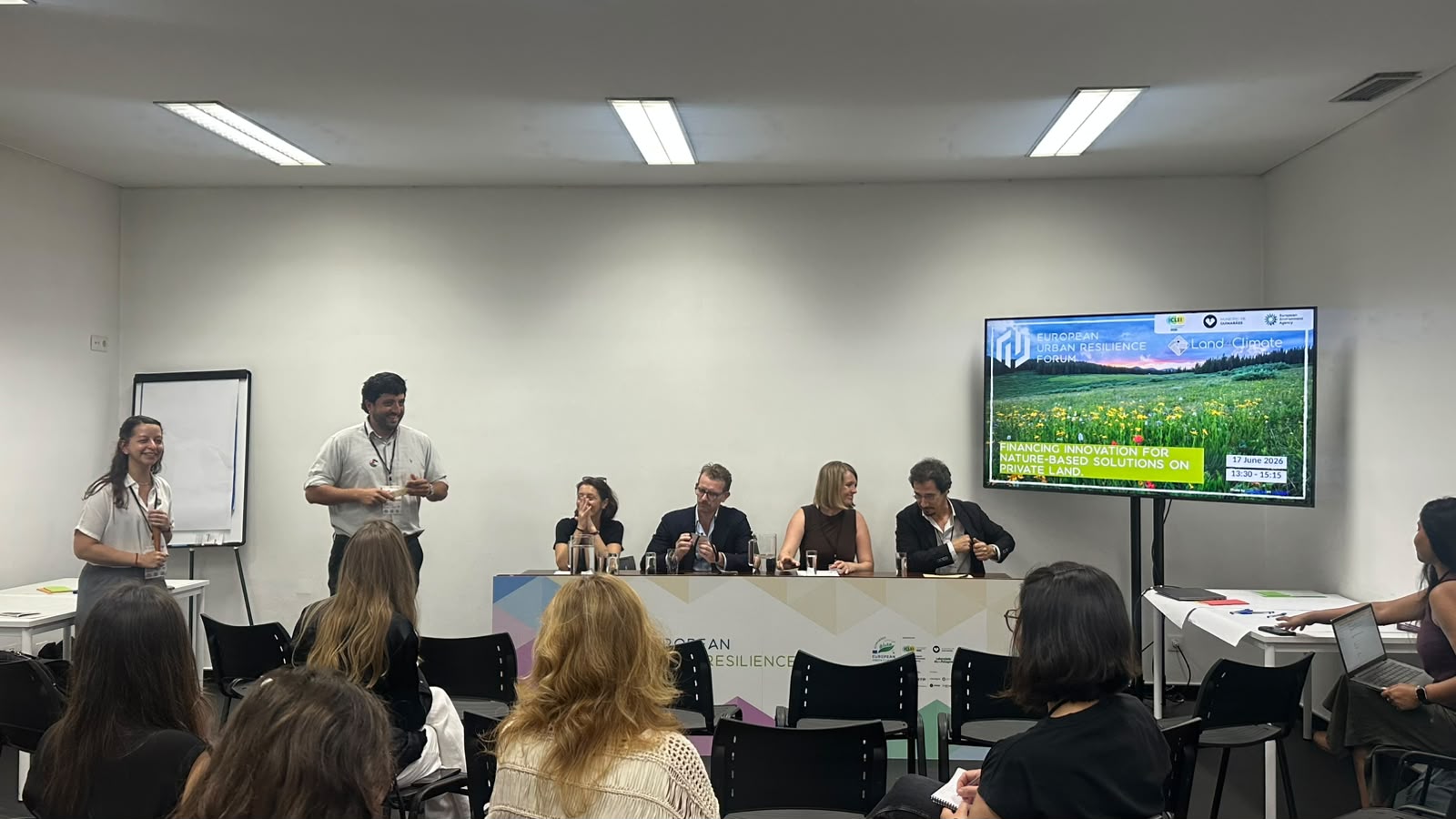
How can Nature-based Solutions (NbS) on private land move beyond individual projects and become financially viable over the long term? This question guided the LAND4CLIMATE session “Financing for Nature-Based Solutions on Private Land”, held on 17 June during the European Urban Resilience Forum 2026 in Guimarães, Portugal. Bringing together experts and practitioners working across finance, governance and NbS, the session explored how public authorities, private landowners and investors can cooperate to develop more sustainable financing models. The discussion highlighted that closing the adaptation finance gap requires looking beyond individual EU-funded projects and creating systems capable of supporting NbS over time.
Recognising the long-term value of nature
Charles Coverdale, economist for the UK Government and the European Commission, highlighted three interconnected barriers to financing adaptation: the need to quantify benefits more effectively, the absence of a shared framework for defining value, and the difficulty of generating reliable and lasting cash flows. Participants stressed that the challenge is not simply finding investment. Financing and governance systems must also recognise the wider economic, environmental and social benefits generated by nature. As Dr Paulo Palha, President of the European Federation of Green Roof and Green Wall Associations (EFB), underlined, biodiversity is increasingly connected to quality of life and economic attractiveness, making NbS an economic priority as well as an environmental one. “Cities without biodiversity lose quality of life, and people do not want to live there. We are no longer talking only about an environmental agenda; this is also an economic agenda. It is time for action now,” said Paulo Palha. Marina Trentin, Project Manager at Ambiente Italia, presented a co-financing example supported by the European Urban Initiative, in which NbS located partly on private property generate benefits for the wider public. The case demonstrated the importance of public-private cooperation, co-design and the involvement of a broad stakeholder community through both top-down and bottom-up processes. Lenka Krištofová, Project Manager at the Agency for the Support of Regional Development Košice and a LAND4CLIMATE partner, brought insights from the project’s Front-Running Regions into the discussion. She shared practical experience of building trust with private landowners through regional water councils and sustained stakeholder dialogue. This process helped identify private landowners interested in implementing NbS, supported by public grants and €500,000 in funding dedicated specifically to these measures.
Three key takeaways
Three main priorities emerged from the session for ensuring the long-term financing of NbS on private land:
- Think beyond EU-funded projects and adopt a more strategic approach: bridging the adaptation finance gap requires moving beyond individual EU-funded projects and developing a more strategic approach to financing NbS.
- Create systems that recognise the full long-term value of nature: the challenge is not simply attracting investment. The real challenge is creating governance and financing systems that recognise the full long-term value of nature.
- Involve a broader stakeholder community: long-term financing for NbS should involve a wider range of stakeholders and combine both bottom-up and top-down approaches.
Want to know more? Have a look at the NBS4EU Cluster: Building Resilience Together for Greater Impact
This article was written by Matteo Caoduro from LAND4CLIMATE consortium partner ICLEI Europe


Publishing date: